
Background and question
Everyday speech can feel clear because familiar patterns help listeners fill gaps even when the medium is noisy. For Science to Experience, we turned that gap between signal and interpretation into a phone interaction that required visitors to decode a distorted voice.
The process
We developed the concept, signal system, physical prototype and public communication as a team; I worked on the amplitude-modulated signal system and the Arduino and PlugData prototype. Amplitude modulation, the process used to alter the voice signal, made decoding part of the message, while the phone-booth format joined touch and hearing by requiring visitors to adjust the installation as they listened.
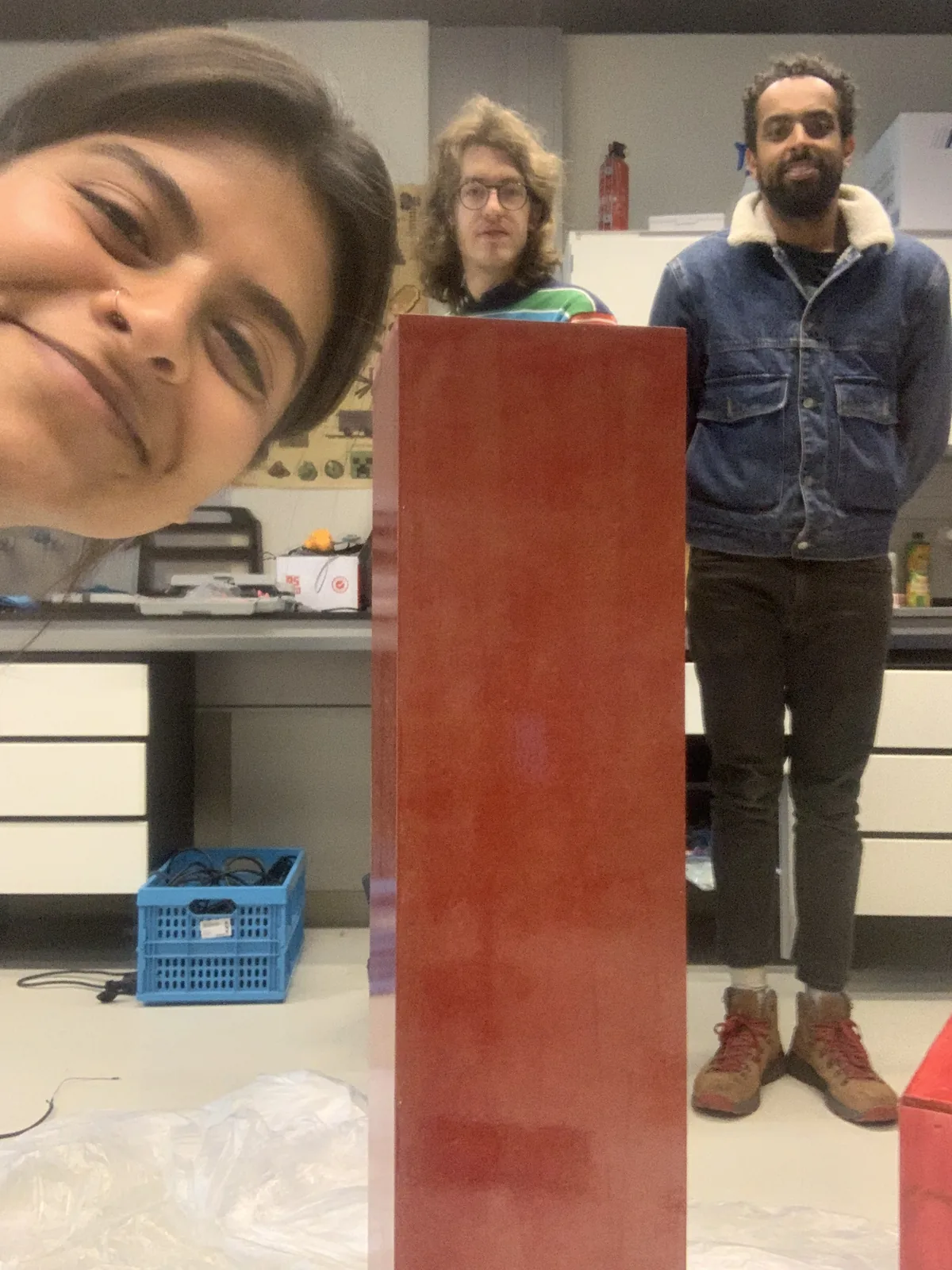
We built two red booths for two-person interaction, but one failed immediately before the exhibition, so we adapted the remaining booth for one visitor and used proximity to trigger the ring. After lifting the handset, the visitor heard instructions and adjusted two dials and two buttons while trying to understand the distorted voice. One dial changed the phone-horn volume and the other changed the signal modulation, while the buttons supported requests for repetition and clarification.
As the dials approached their target settings, the voice became clearer, signalling that the visitor’s adjustments were working. In the two-interlocutor concept, message recovery was followed by a drop-call tone, after which modulation was randomized and the visitor heard their own speech as the other speaker.
Outcome
The installation was exhibited at V2_ in Rotterdam, where the remaining booth stood against a wall in the middle of the exhibition space and rang when a visitor came close, inviting them to pick up the handset. The record does not establish whether its final trigger played the visitor’s earlier speech.

Limitations and next steps
The final setup accommodated one visitor at a time, and nearby people could make the call difficult to follow. The project record contains no verified visitor count or structured feedback, so its intended effects remain untested.